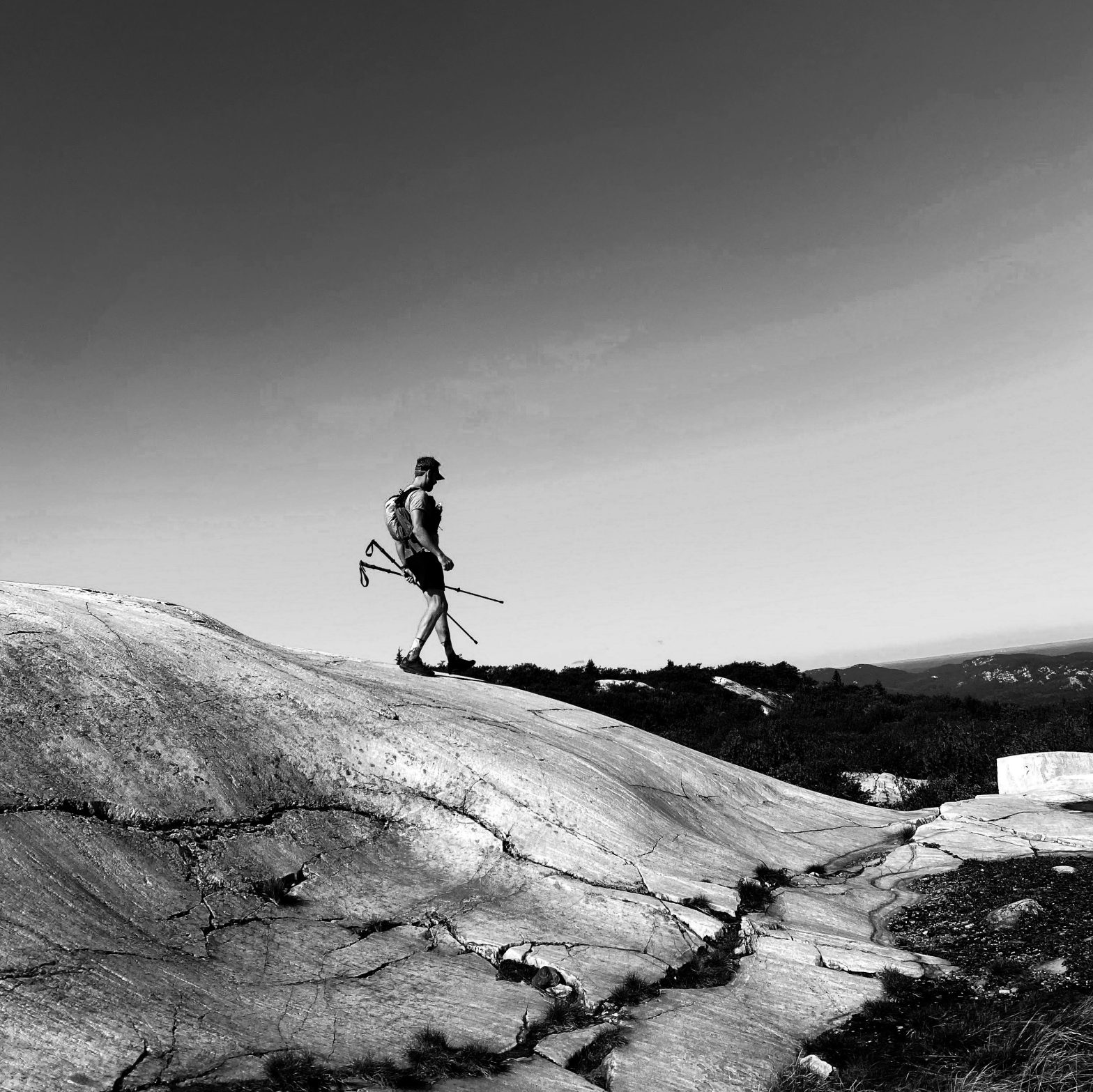
Despite the resurgence of ultramarathon races post 2020-season cancellations, venturing out to Killarney to run the full La Cloche Silhouette trail has maintained a constant pull on my running ambitions. La Cloche was the trail that ignited my passion for backpacking, which leant itself to climbing, then to alpinism, to hobby-jogging when climbing gym closed due to the pandemic, to serious ultra-running and racing. Now, having just completed running La Cloche in its entirety, I find myself back where I began, the same yet entirely different.
Running La Cloche felt like the end of an early chapter in my outdoor pursuits; something that remained unfinished before moving on to bigger things. I’ve done my best to recount my experience in hopes that it might inform – or perhaps inspire? – others who seek to do the same.

Trip Report
Anticipation and angst meant I didn’t hit snooze when my 4 a.m. alarm nagged me out of my sleeping bag. After a cup of coffee, two leftover pancakes from the previous night’s breakfast-for-dinner (highly recommended), and a reluctant shedding of my warm puffy, we started the running watches* and set out at 4:50 a.m. from George Lake’s campsite 30, fittingly the single farthest point from the eastern trailhead of the La Cloche Silhouette Trail.
(*in a rather pointless attempt at good style, we ran a true loop: campsite to campsite rather than the usual east trailhead to west trailhead loop, adding a few kilometres)
We began the trail in a counterclockwise fashion, allowing early egress on day-hiking side trails should any nagging injuries rear their ugly head (such options do not exist after the first third of the trail). The goal was not to gun for a fast completion time, nor the vaunted FKT, but to get it done in good style and get back to camp without allowing misery to completely take over our day.
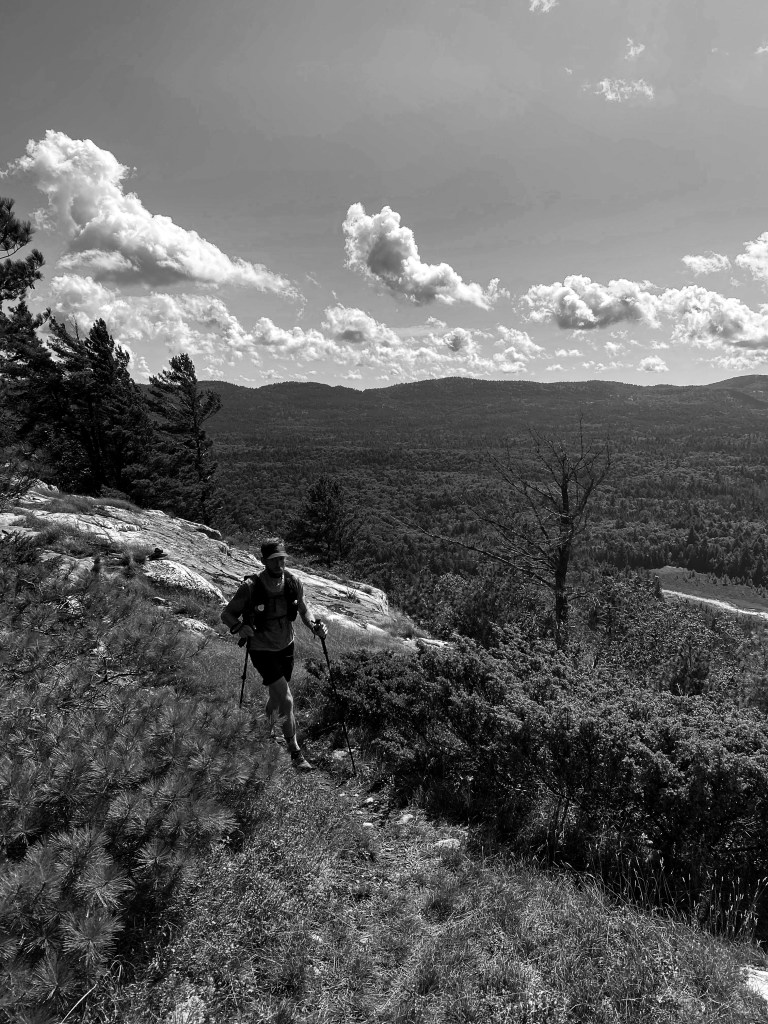
Upon starting the trail proper, we immediately had to contend with the difficulty of navigating La Cloche’s characteristic mix of granite slab and deep forest by headlamp. After a brief acclimatization (and some fresh headlight batteries), we were well on our way to the Crack, travelling quickly on reasonably runnable terrain. We arrived at the top of the Crack at sunrise, where we were surprised and disheartened to see a number of hammock campers had spent the night.
The reality of the rest of the trail to come set in once we left the Crack. Terrain and trail conditions suitable to fast travel became a distant memory, replaced by sudden and relentless transitions between steep ascents and descents on generally very rocky, rooted singletrack. The mental concentration required to move quickly on such terrain proved to be the real crux of the day, as the challenge rarely let up from this point onward.
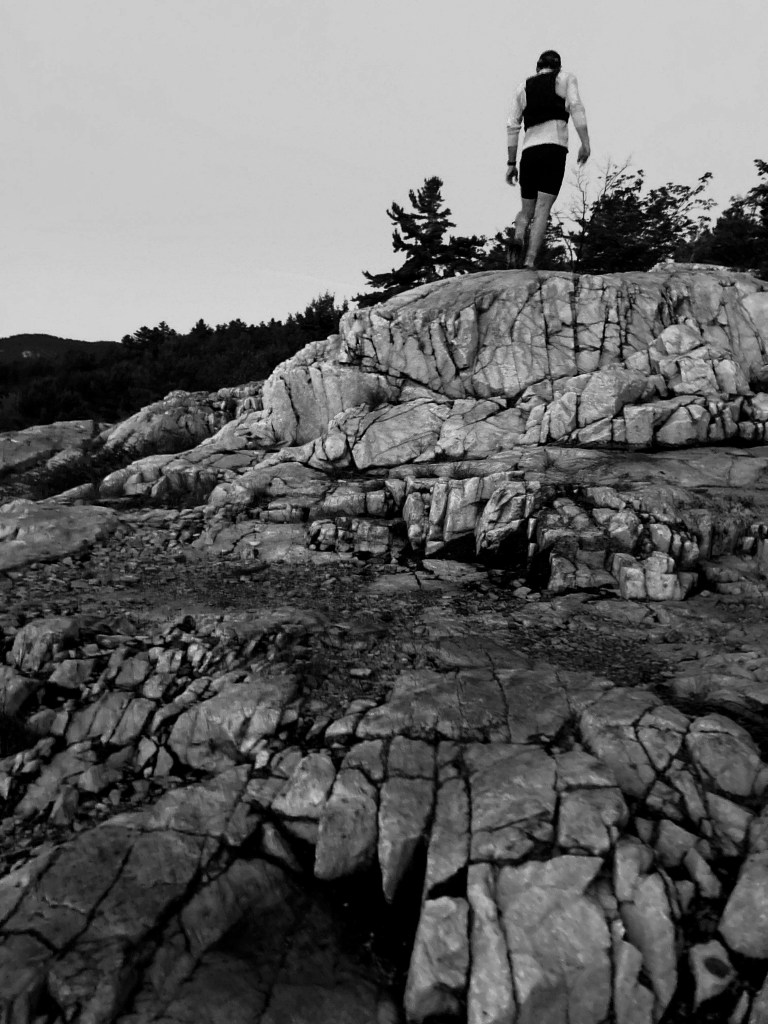
We were granted a short break in the form of a brief portion of runnable double-track on the way to the Silver Peak side trail junction. Feeling strong, adventurous, motivated and a little stupid, we elected in a split second decision to add the Silver Peak side trail to our loop. We ascended, tagged the summit, inhaled a few PB&Js, and descended in well under and hour, and continued our loop. The views at the top were well worth the climb, as was the change of pace from the relentless mental grind of the rugged forest trails. While grateful for the brief diversion, we joked the added elevation might come back to haunt us.
The next 20 kilometres were as beautiful as they were relentless. Dangerously root-y forested sections were punctuated by stunning exposed granite ridges, which offered short glimpses of fast travel. The direct sun on the high slabs was punishing, but we were treated to the occasional refreshing northern gust of wind as we traversed the more exposed parts of the La Cloche high ridge. This section was perhaps most defined by the steep ascent up Moose Pass, where distant trail markers leered at us from above tall sections of exposed granite, with no clear path or direction other than “up”.
As we exited the Hansen Township section and entered Threenarrows, I had my first and thankfully only moment of deep-seated worry, as my outer thighs began threatening to cramp, causing my stride to stiffen. In turn, my now-awkward stride quickly brought on a sharp inner knee pain each time my left foot hit the ground. Thankfully, something in the cocktail of salt pills, ibuprofen and water I nervously sucked back kept the potential injury at bay. The potentially disastrous ramifications of an injury so far into the backcountry were jarring, despite the degree to which we had prepared for such a moment. To be 55 kilometres into an attempt to run the La Cloche loop is to be truly alone, and to be there worrying about injury without true shelter only made the feeling more exposed and sobering.

The remainder of the run was blissfully uneventful, though our mental fortitude began to give way to regular distance check-ins and the occasional muttered complaint as we closed in on the final 20 kilometres back to camp. As we tired, turn-offs and trail markers were missed, backtracks were more frequent, and morale was tested. The terrain remained too technical to run with any consistency, forcing us to run where possible only to give up after a few hundred meters in favour of a feverish-yet-laboured power hike.

In the final few kilometres, familiar sights and the ever-closer promise of the comfort of our campsite kept the pace quick (or at least it felt quick at the time), and after a quick fist-bump on the bridge that marked the western trailhead, we speed-shuffled back to our distant campsite, quietly cursing our idealized full loop from campsite to campsite idea. We arrived back at camp 16 hours after we left for a total distance of 82.59 kilometres and a total elevation gain of a whopping 3,267 meters.
I can hardly remember eating dinner, and I certainly can’t remember falling asleep.
Yes, I would do it again.
Type Two Rating: 50%

Thoughts on Gear
On to the fun stuff. Gear selection for this attempt was subject to much scrutiny, but the final decisions proved to work in a general sense.
VJ Ultras were the shoe of choice for this run, given their ideal balance between cushion and ground feel and their emphasis on grip for potentially slick granite slab, wet roots, and classic Killarney clay-rich mud. They performed admirably – especially on wet terrain – despite my relative lack of experience with them (I had only put 50 kilometres on them prior to La Cloche).
The Salomon Sense Pro 10 was the vest of choice for this run. A 10 litre capacity vest for an unsupported 80+ kilometre run was certainly a risk, but with careful packing and plenty stored in the front pockets, it proved adequately roomy. Comfort was excellent despite humid, sweaty conditions through a very long day on the trail. I used the standard Solomon soft flasks, topped with dual Salomon XA filters for quick water filtration on trail – this setup was crucial in order to minimize wasted time actively filtering water. I carried a third, empty Salomon soft flask in the main vest pocket to fill and carry through longer sections that were without reasonable expectation of water access, though this proved unnecessary and the third flask was never used.
Layers were simple, and brought to you by a well-timed Patagonia sale: A Patagonia Capilene baselayer, coupled with a (seldom-used) Airshed Pullover for wind and light precipitation. While shorts may not seem like a gear choice worthy of discussion, I should call out Patagonia’s now-discontinued Endless Run hybrid short/tight for stellar all-day comfort and truly excellent pockets. For long efforts like these, the chafe protection and ample storage make them worth the increased weight over a pair of split shorts. Fair warning – they look stupid as heck.
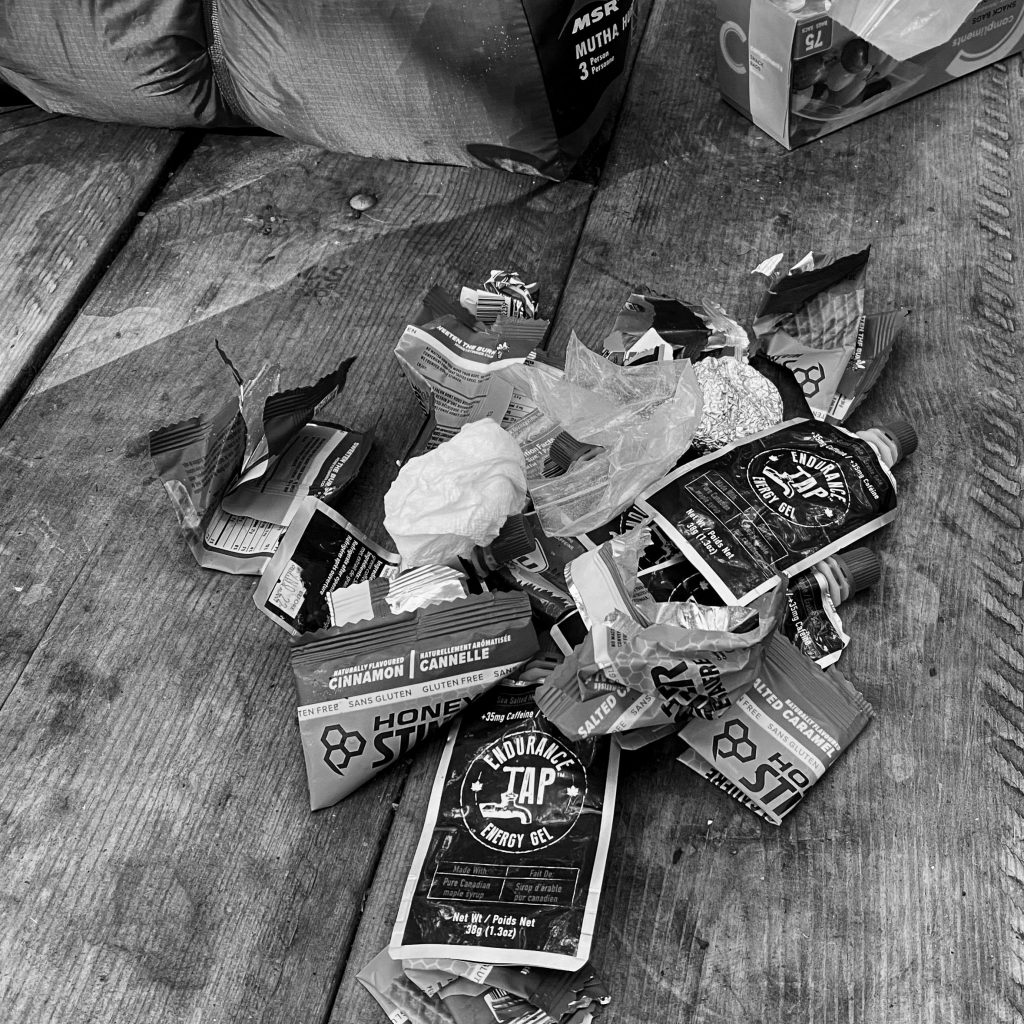
Nutrition was a case of “if it isn’t broke, don’t fix it”. Tailwind, stroopwafels and (caffeinated) Endurance Taps made up the bulk of my calorie intake. A peanut butter & jam (no one likes jelly) sandwich and some salt & vinegar cashews quelled palate fatigue and provided some much needed fat and salt, while a couple Snickers bars ended up being the star of the show – every full day out in the backcountry needs a snack that you actually look forward to consuming.
Safety gear took the form of a Garmin InReach, a single down puffy and Gore-Tex ShakeDry shell (each to be shared if needed), and a well-stocked first aid kit. Shelter was omitted by virtue of the excellent weather forecast, though I am well aware of the increased risk created by this decision.
Photos by Ethan Frank, Andrew Higgins
 type two fun